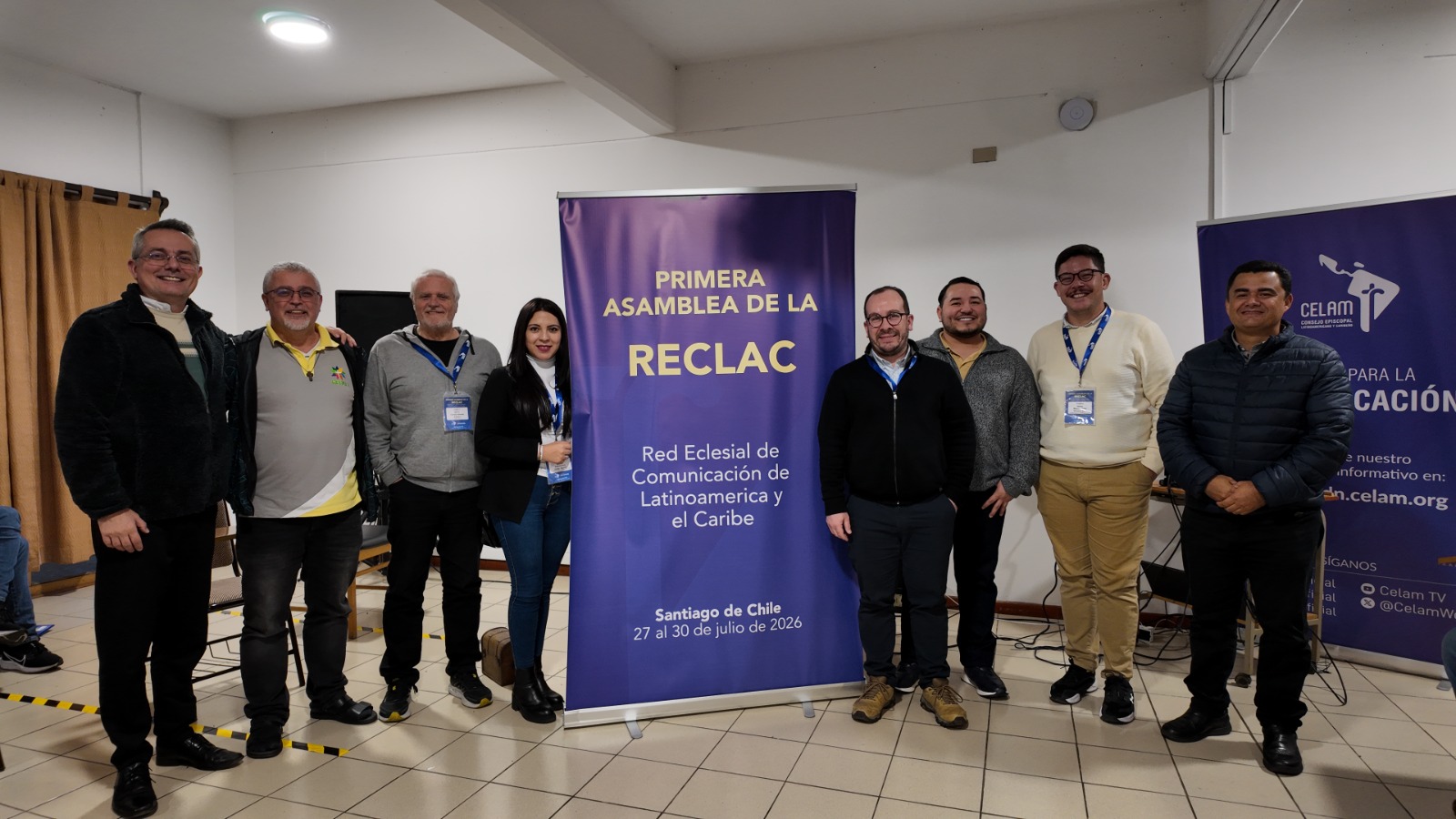
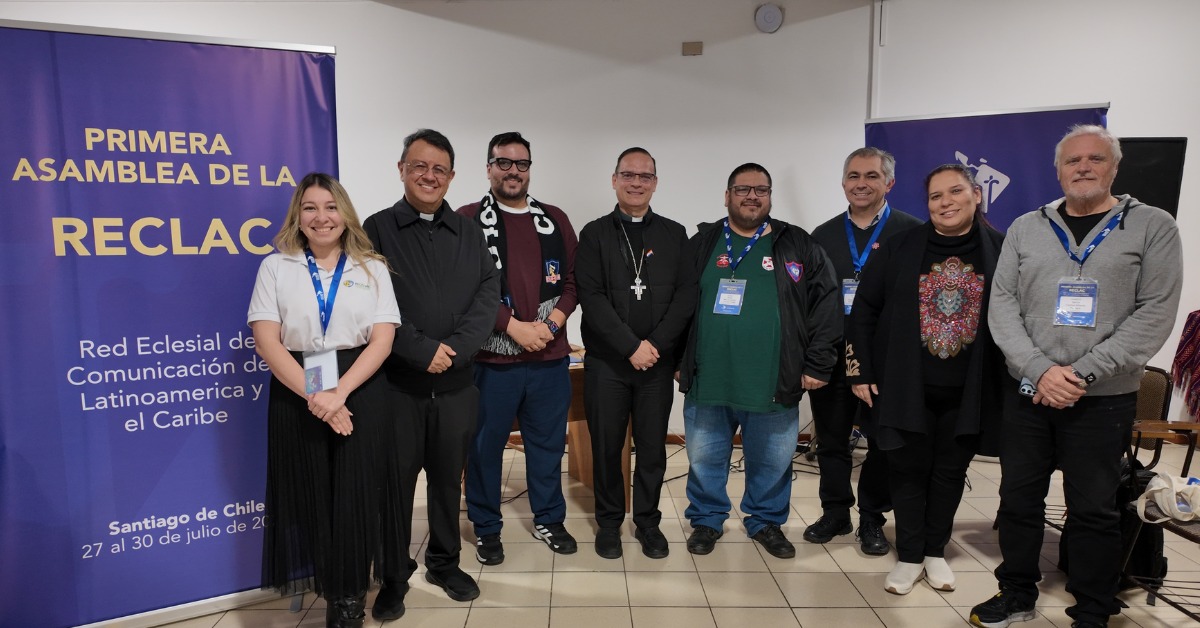
The Church Communication Network of Latin America and the Caribbean (RECLAC) concluded its First General Assembly in Santiago, Chile, with a call to strengthen ecclesial communication centered on Jesus Christ and committed to synodality, human dignity, and peacebuilding. CEAMA was represented by its Communications Coordinator, Fernando Rueda, who reaffirmed its commitment to this process of continental coordination.
The Ecclesial Communication Network of Latin America and the Caribbean (RECLAC) held its First General Assembly in Santiago, Chile—a historic event that marked a decisive step in the consolidation of this space for communion, coordination, and service for the Church’s communicators across the continent.
Over several days of work, discernment, and fellowship, representatives of episcopal conferences, ecclesial organizations, communication networks, and communicators from Latin America and the Caribbean renewed their commitment to evangelizing communication inspired by communion, synodality, and hope, placing Jesus Christ at the center of all communicative action.
Representing the Ecclesial Conference of the Amazon (CEAMA) was Fernando Rueda, Communications Coordinator, who participated in this process of discernment and collective building aimed at strengthening the Church’s mission of communication in the region.
Communication Rooted in the Gospel
At the conclusion of the Assembly, the participants addressed a message to ecclesial communicators in Latin America and the Caribbean, expressing their gratitude to the continent’s bishops for the trust and support they have shown to those who exercise the ministry of communication in the service of evangelization.
They also recognized all the individuals and institutions that made the founding of RECLAC possible as a space for encounter, communion, and collaboration among the Churches of the continent.
The network’s members reaffirmed their decision to continue walking alongside their pastors, convinced that communication lived in communion strengthens the evangelizing mission and makes the face of Christ visible among the peoples of Latin America and the Caribbean.
Artificial Intelligence in the Service of the Person
As part of the Assembly, participants took part in the 7th International Seminar on Church Communications, held at the Pontifical Catholic University of Chile, where they reflected on the ethical, pastoral, and evangelizing challenges that artificial intelligence poses for ecclesial communication.
The reflection was informed by the recent encyclical *Magnifica Humanitas*, which reaffirms the centrality of the human person in the face of technological advances.
Communicators agreed that the development of artificial intelligence only takes on its full meaning when it is oriented toward serving human dignity, truth, the common good, and the building of a culture of encounter.
A Historic Step for Church Communication
During the Assembly, the RECLAC Statutes were approved, legally consolidating this continental space for coordination and collaboration.
Likewise, the first continental coordination team was elected, composed of representatives from the regions of Central America and Mexico (CAMEX), the Bolivarian region, the Caribbean, and the Southern Cone, along with representatives from ecclesial organizations, the coordinating bishop, the Director of the CELAM Center for Communications, and a representative from SIGNIS Latin America and the Caribbean.
As part of this organizational process, eight working groups were also established to guide the network’s mission:
• Pastoral Care in Communication.
• Communication in Synodality.
• Education and Training.
• Digital Culture, Artificial Intelligence, Technological Ethics, and New Narratives.
• Coordination for Advocacy.
• Safeguarding and a Culture of Care.
• Funding and Support for Communication.
• Care for Our Common Home.
These initiatives will seek to collaboratively address the communication challenges facing the Church in Latin America and the Caribbean.
Solidarity with Venezuela and Cuba
The Assembly also expressed its solidarity with the Venezuelan people in the face of the consequences of the recent earthquakes that have affected numerous families and communities.
Similarly, it expressed its solidarity with the Cuban people, who continue to face the effects of a prolonged energy crisis that is impacting the daily lives of millions of people.
The members of RECLAC reiterated their commitment to accompany these realities through the Church’s mission of communication, raising awareness of their challenges, promoting solidarity, and strengthening communication that contributes to fraternity and peace.
Communicating to Build Fraternity
In its closing message, the Assembly recalled that all ecclesial communication finds its purpose in proclaiming Jesus Christ and promoting the dignity of every human person.
It also reaffirmed the commitment to work for peace, the care of our common home, and the building of a culture of encounter—especially in a context marked by poverty, exclusion, and the various forms of violence affecting the peoples of the continent.
The communicators embraced Pope Leo XIV’s call to “strip words of all aggression,” convinced that communication can become a bridge of reconciliation, hope, and fraternity.
With this First General Assembly, RECLAC begins a new phase in the service of the Latin American and Caribbean Church, strengthening collaboration between communicators and ecclesial organizations to proclaim the Gospel with creativity, responsibility, and a synodal spirit, responding to the challenges of our time with communication that always places life, human dignity, and care for our Common Home at the center.