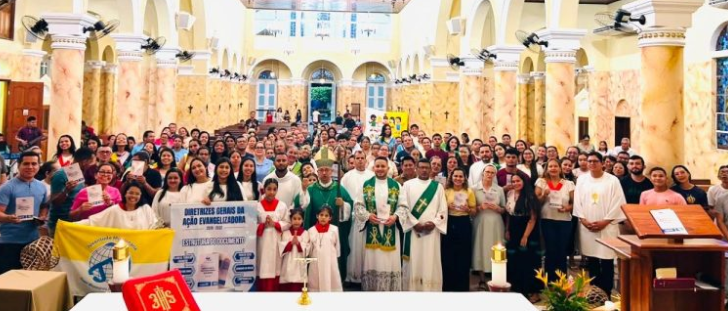
The Diocese of Borba, in the state of Amazonas (Brazil), brought together more than 600 pastoral workers—both religious and laypeople—for an intensive ten-day Formation Day that provided opportunities for formation, spirituality, and the strengthening of the evangelizing mission in Amazonian communities.
The activities took place simultaneously in various parishes and communities throughout the diocese and concluded on July 11 with the celebration of the Holy Eucharist at the Basilica of St. Anthony in the municipality of Borba, presided over by B Bishop Zenildo Luiz PereiraB , bishop of the diocese.
Formation for a Church That Is Close to the People and Servant-Oriented
One of the formation sessions was directed at the executive secretaries of the parishes and missionary areas of the diocese. In addition to receiving training on the Diocesan Curia’s digital system, participants explored the human dimension of pastoral service in greater depth.
Psychologist and deacon Leonardo Lucas Cunha, from the Archdiocese of Manaus, highlighted the importance of holistic care for those who carry out pastoral work in the communities, emphasizing that ecclesial service requires spiritual, human, and emotional balance, as well as respectful and fraternal communication with all people.
Young People Called to Walk in Synodality
The Formation Day also brought together the diocese’s Youth Sector, with the participation of representatives from the Missionary Youth, Youth Ministry, the Orionite Youth Movement, and the Catholic Charismatic Renewal.
Under the theme “Forming to Serve, Living in Communion, and Evangelizing”, the young people reflected on their vocation based on the story of the disciples of Emmaus and delved deeper into the call to build a synodal youth ministry, integrated with other pastoral ministries and ecclesial movements.
During the gathering, Bishop Zenildo Luiz Pereira reminded the participants that young people are the present and the future of the Church and emphasized the need to strengthen their active role within the communities.
“Young people cannot walk alone; they need to walk alongside priests, families, and pastoral ministries,” the bishop said as he encouraged the participants to joyfully proclaim that Christ is alive.
The Eucharist, the Center of Christian Life
The formation program for extraordinary ministers and lay leaders focused on the Eucharist as the source and summit of the Church’s life.
Theologian Matthias Grenzer explored the meaning of Jesus’ Last Supper and the importance of the Psalms within the Liturgy of the Word, inviting participants to rediscover the spiritual and pastoral richness of the Eucharistic celebration.
The Mission Begins in Childhood
Another session was dedicated to the Missionary Childhood and Adolescence (IAM) program, with the participation of coordinators and advisors who accompany children and adolescents in the diocese.
At this meeting, Bishop Zenildo Luiz reflected on the identity of the missionary disciple, recalling that following Jesus Christ and proclaiming the Gospel are part of the same vocation.
The bishop encouraged pastoral workers to cultivate a spirituality deeply rooted in God’s love, the foundation of all evangelizing action.
The Family, the First School of Faith
Family Ministry also played a prominent role during the Formation Day with the theme “Marital Spirituality: The Family as the Domestic Church, Witness to God’s Love.”
In his reflection, the Bishop of Borba emphasized that the family is the primary setting where faith is lived out and passed on. He invited families to place Christ at the center of family life, strengthening prayer, dialogue, the education of children, and commitment to Gospel values.
He also recalled the teaching of Benedict XVI’s encyclical *Deus Caritas Est*, emphasizing that Christian love is not merely a feeling, but a vocation and a commitment that transforms daily life.
A Missionary Mandate for the Entire Diocese
To conclude the Formation Day, Bishop Zenildo Luiz presented the communities with the General Guidelines for the Evangelizing Action of the Church in Brazil (DGAE 2026–2032), a document approved by the National Conference of Bishops of Brazil (CNBB), which will guide the diocese’s pastoral work in the coming years.
The bishop invited the participants to return to their communities carrying with them not only new knowledge but also a renewed commitment to evangelization, communion, and service to the People of God.
The experience in Borba reflects the dynamism of a Church that is committed to the ongoing formation of its pastoral workers as a way to respond to the challenges of the Amazon.