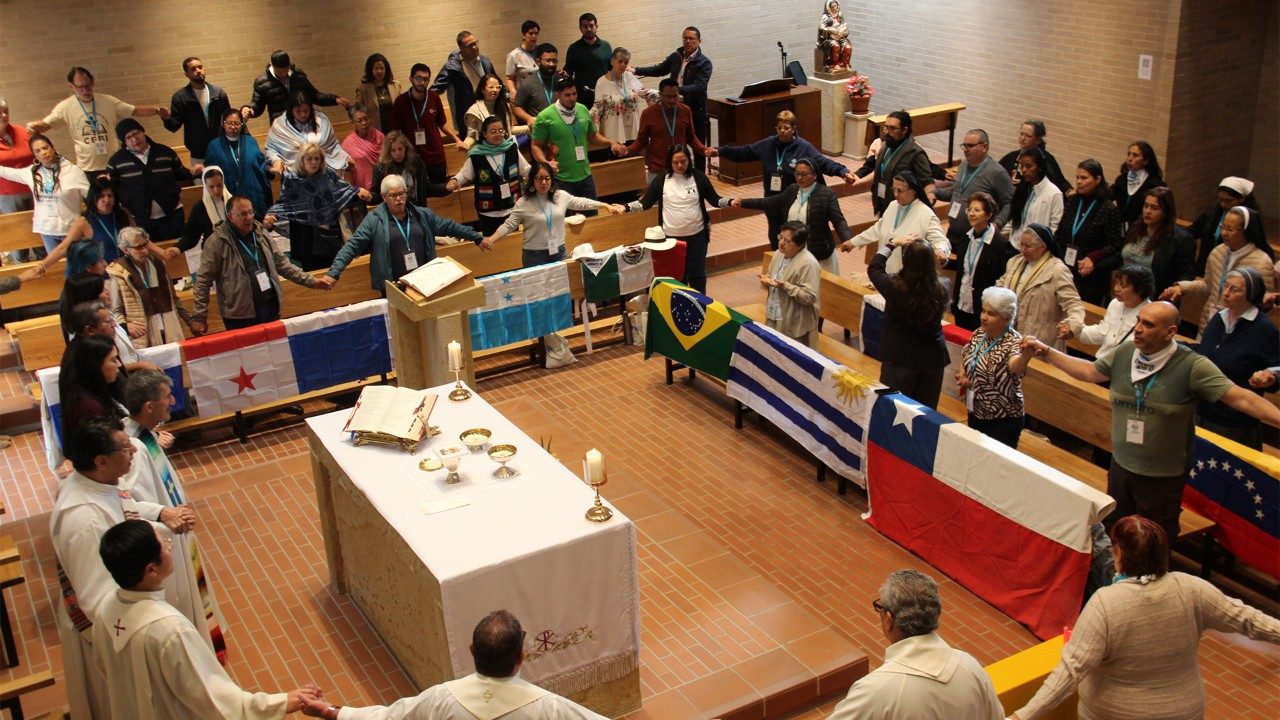
With a call to strengthen synodality and ecological conversion in Latin America, the First Hispanic-American Meeting of the Laudato Si’ Movement concluded in Bogotá, bringing together 110 facilitators and volunteers from 19 countries, along with nearly 300 participants who joined the process virtually.
Held October 2–4 at the headquarters of the Latin American and Caribbean Episcopal Council (CELAM), the meeting’s theme was “Walking Together to Care for Our Common Home” and served as a space for listening, prayer, reflection, and discernment regarding the socio-environmental challenges facing the region.
The closing day coincided with the feast of St. Francis of Assisi and the conclusion of the Season of Creation 2026, whose theme, “Living Water,” invited participants to deepen their commitment to caring for life and our Common Home.
A Church That Hears the Cry of the Earth and of the Poor
One of the central themes of the gathering was reflection on eco-synodality, understood as a way of living out synodality from the perspective of integral ecology.
During the panel discussion “Walking Together: Living Synodality Through the Lens of Integral Ecology,” participants explored the Church’s journey since the Second Vatican Council and the lessons learned from the synodal process, highlighting the challenge of broadening our listening to the cry of the peoples, the poor, and creation.
The reflections emphasized that the environmental crisis, social justice, peace, decent work, and the defense of human rights cannot be addressed as isolated issues. They are all part of the same reality and a common calling: to care for life and protect our Common Home.
This approach takes on special relevance for the Amazon, where communities, indigenous peoples, women, young people, and defenders of the territory directly experience the impacts of the socio-environmental crisis and, at the same time, sustain initiatives to care for and defend life.
Measuring, Walking, and Sowing
During the meeting, Sister Alessandra Smerilli, Prefect of the Dicastery for Promoting Integral Human Development, sent a message of solidarity to the participants from Rome and proposed three verbs to guide the Movement’s path: measuring, walking, and sowing.
She reminded the gathering that issues related to the environment, social justice, peace, decent work, and human rights are all part of the same fabric and called for maintaining hope in the face of current challenges.
Her invitation was summed up in a phrase that concluded the gathering: “Measure by the standard of integral ecology, walk together with the least among us, sow without tiring.”
From the Gathering to Commitment
Beyond opportunities for formation and reflection, the gathering sought to offer a concrete experience of synodality. Through “Conversations in the Spirit,” participants shared their experiences and discerned the changes needed to strengthen a more participatory and communal way of being the Laudato Si’ Movement in the region.
There were also opportunities for contemplation and eco-spirituality, reminding participants that caring for creation begins not only with action but also with the ability to pause, contemplate, listen, and reconnect with all of creation.
On this journey, the spirituality of integral ecology was presented as a fundamental dimension for fostering processes of personal, communal, and social transformation.
A Regional Manifesto to Continue the Journey
One of the main outcomes of the gathering was the presentation of the Regional Manifesto of the First Hispanic-American Gathering of the Laudato Si’ Movement, drafted based on the voices, priorities, and commitments that emerged during the days of dialogue, prayer, formation, and discernment.
The document sets forth a shared vision to strengthen the Movement’s action in the face of Latin America’s socio-ecological challenges and proposes continuing to move toward a more synodal, coordinated, and committed presence in local communities.
The closing ceremony was accompanied by a Sending-Off Mass, which served as a reminder that the gathering does not mark an end, but rather a new beginning. Participants returned to their countries and communities committed to putting into practice what they had discerned in Bogotá and to continuing to promote processes of ecological conversion and concrete actions for our Common Home.