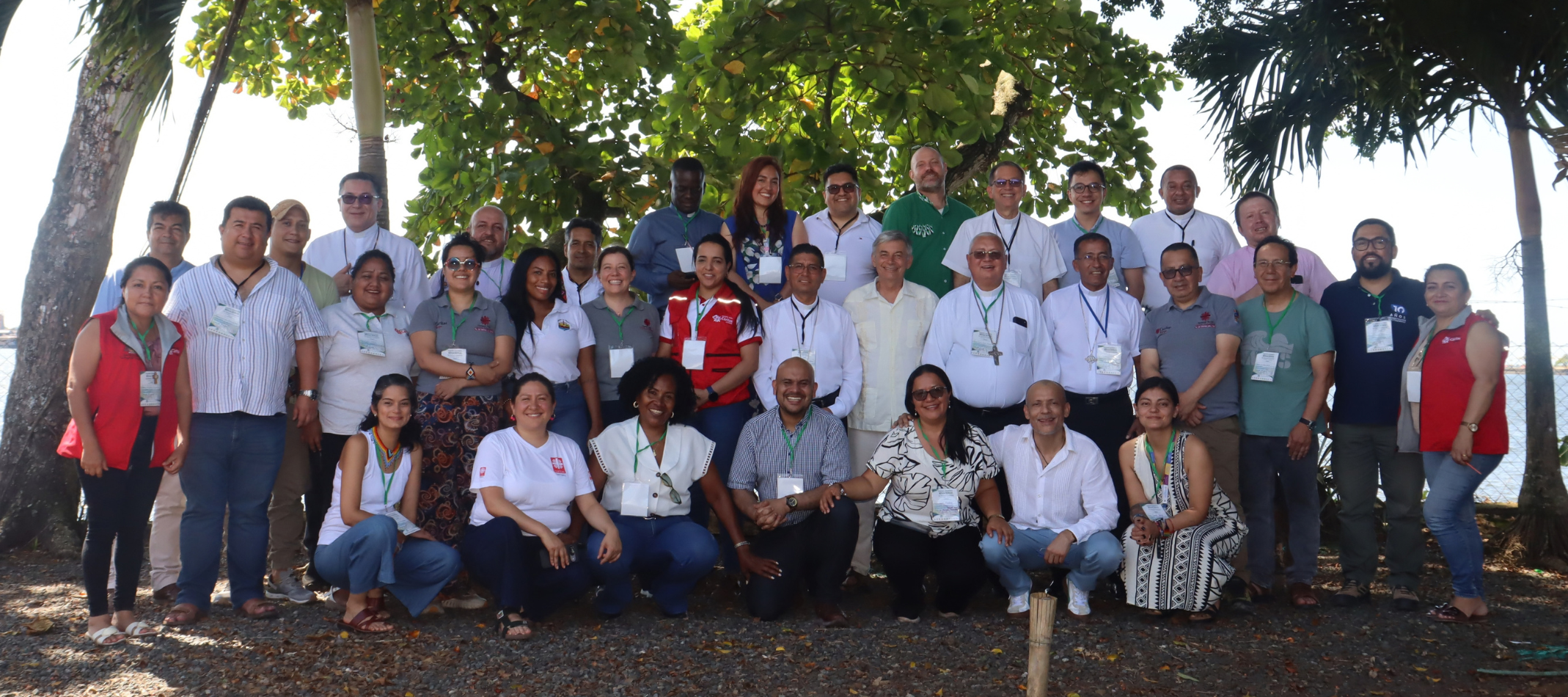
The Churches of Colombia and Ecuador renewed their commitment to accompany the peoples living in border territories during the Second Binational Meeting on Border Pastoral Care, held in October 2026 in Tumaco, Nariño. The meeting provided an opportunity to share insights into the realities of the Pacific, Andean, and Amazonian corridors, acknowledge the challenges faced by communities, and strengthen avenues of cooperation in defense of life, human dignity, and care for our Common Home.
The meeting brought together representatives from the eight ecclesiastical jurisdictions that serve the Colombian-Ecuadorian border, along with Caritas Ecuador and the National Secretariat for Social Ministry–Caritas Colombia. The participating Churches reaffirmed a 34-year journey of closeness, cooperation, and solidarity with communities affected by violence, humanitarian crises, and various forms of exclusion.
A border marked by social and environmental challenges
During the meeting, participants analyzed the complex realities facing the border territories. Although the border represents a space for exchange, cultural richness, and encounter among Indigenous peoples, Afro-descendant communities, rural communities, and migrant families, it also faces serious problems related to drug trafficking, illegal mining, smuggling, arms trafficking, extortion, and human trafficking.
The Churches expressed their concern about the forms of violence that affect the daily lives of communities, especially those that remain hidden beneath dynamics of fear, confinement, and social control. In this context, they reaffirmed the need to stand in solidarity with those who suffer threats, displacement, recruitment, exploitation, and other violations of their rights.
The final statement highlights the importance of providing special support to indigenous peoples, Afro-descendant communities, rural families, migrants and refugees, women, and children and adolescents, who experience the consequences of this violence with particular intensity.
Added to these concerns are environmental threats. Illegal mining, illicit crop cultivation, deforestation, and the pollution of rivers and water sources—as well as the effects of climate variability—jeopardize the health, food security, and continued presence of numerous communities in their territories.
Faced with this reality, the Churches emphasized that defending human life and caring for our Common Home are inseparable responsibilities, especially in areas where environmental degradation exacerbates inequalities and threatens people’s livelihoods.
A Church That Welcomes, Protects, and Builds Bridges
In the face of these challenges, the participating Churches noted that border security cannot be limited to the control of border crossings or to exclusively military responses. Peacebuilding also requires dignified opportunities for life, institutions that are close to communities, humanitarian protection, justice, environmental stewardship, and effective cooperation between Colombia and Ecuador.
Grounded in their evangelizing identity, the Churches expressed their commitment to continuing to be a presence close to the people, capable of listening to their needs, accompanying their community processes, and contributing to the building of paths toward justice, reconciliation, and peace.
The daily presence of parishes, communities, pastoral workers, and church organizations on both sides of the border is a source of strength for responding to the needs of the population and promoting initiatives that protect human dignity.
Three Paths to Strengthen the Border Mission
As a result of the meeting, the participants committed to strengthening three lines of joint action:
- Analysis and discernment of reality: to maintain ongoing reflection on border dynamics and preserve the memory of the peoples who inhabit these territories.
- Pastoral and community action: strengthening initiatives for the protection of life, peacebuilding and reconciliation, humanitarian response, and care for our Common Home.
- Binational coordination and advocacy: deepening joint work with communities, public institutions, social organizations, international cooperation agencies, and other actors present in the territories.
They also issued a fraternal call to the authorities of Colombia and Ecuador, to social organizations, and to international cooperation to assume shared responsibility for the issues affecting border communities.
The Churches recalled that these realities exceed the response capacity of a single country and require coordinated decisions that place people, their rights, and their communities at the center.
A Border Where the Gospel Invites Encounter
At the conclusion of the Second Binational Meeting on Border Pastoral Care, the Churches renewed their commitment to walk together, to stand alongside those who suffer, and to recognize the capacity of border communities to protect life, resist violence, and build hope.
This commitment expresses a way of living out the Church’s mission through listening, closeness, and coordinated work with communities, recognizing that the border is not merely a geographic or political boundary, but also a space for encounter, solidarity, and fraternity.
“Where political boundaries separate us, the Gospel calls us to recognize one another as brothers and sisters,” states the meeting’s final communiqué.